Three Elections, One Region: Latin America's 2026 Political Calendar
Between April and October 2026, three of Latin America's most important economies will elect new presidents. Peru votes on 12 April, Colombia holds its first round on 31 May and Brazil follows in October. Together, these three countries account for more than 55% of the region's GDP.
All three elections are taking place against a backdrop of fiscal pressure, the Iran oil shock, and a political realignment that accelerated with Milei in Argentina, Noboa in Ecuador, and Kast's inauguration in Chile this month. But as the Colombian case illustrates, that realignment is not a foregone conclusion. The outcomes of these three races will determine the evolution of the region's current investment-friendly environment.
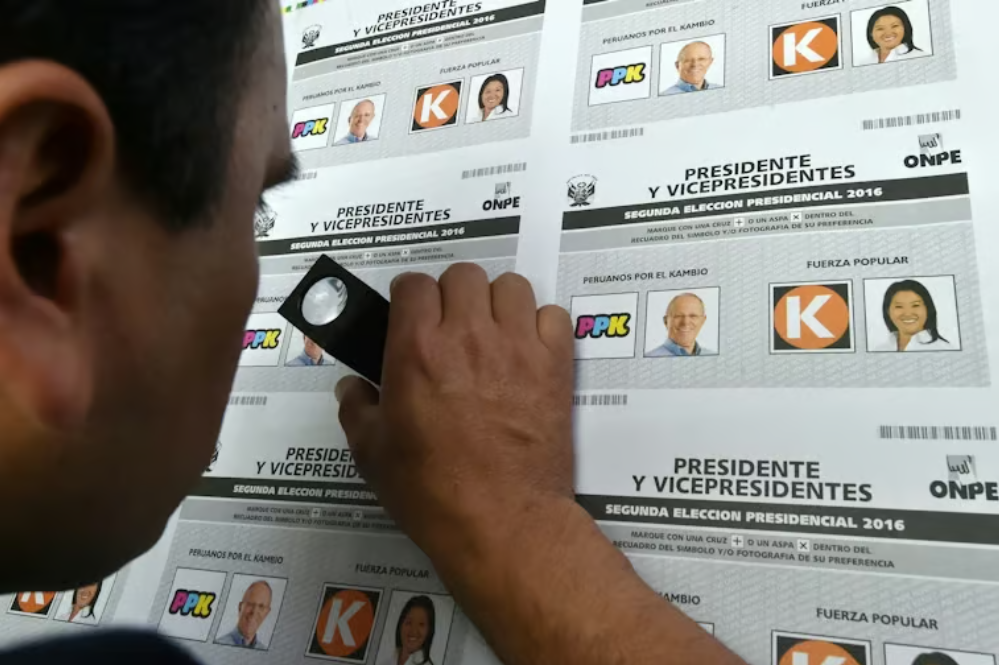
Since 2016 and the election of Pedro Pablo Kuczynski, Peru has had seven different presidents
Peru: first test, highest uncertainty (12 April)
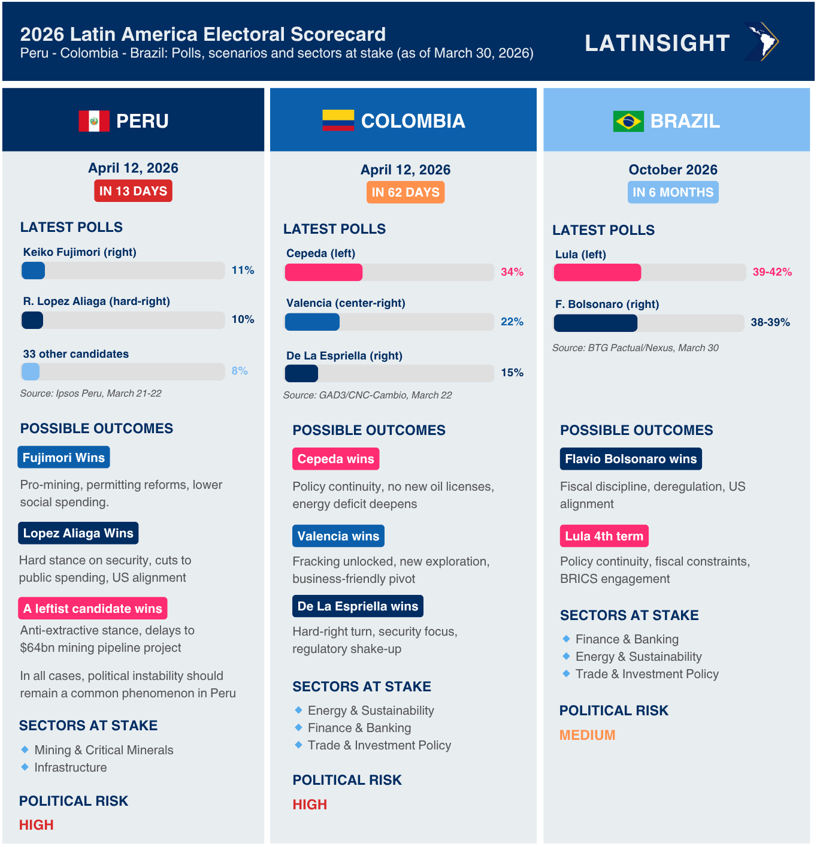
Peru will elect its new president on April 12, 2026, after José Jerí was removed from office by Congress in February, making him the country's seventh president in nine years. The race is deeply fragmented, but two right-wing candidates have polled atop a crowded field of 35 presidential hopefuls. Keiko Fujimori, running for the fourth time, having made the last three runoffs, holds steady at 11-13% across polls. She has pledged to deploy troops and military intelligence to combat street violence, place the military temporarily in charge of the prison system, and launch a "deregulatory shock" for the economy. Rafael López Aliaga, the former Lima mayor who styles himself as Peru's version of Trump and Milei, polls at 9-12%. He has vowed to slash red tape, shutter most government ministries, deploy troops to borders, and use military courts for civilian prosecutions.
Both candidates face active legal investigations: Fujimori over her party's ties to corruption during her father's presidency, López Aliaga over allegedly illegal municipal bonds worth $1.1 billion issued during his time as Lima's mayor.
Left-wing economist and former central bank director Alfonso López Chau has risen to 6.5% from 5.1% in the prior poll, closing in on the two frontrunners.
A runoff between the two right-wing leaders is the most probable scenario, but analysts warn that the next president could come to power with very weak initial legitimacy, facing an equally fragmented bicameral Congress that could deepen political instability and legislative gridlock.
In Peru, 75% of citizens believe the candidates do not understand their real problems, yet the economy tells a different story. Peru's GDP expanded 3.54% year-on-year in January, driven by increased production of copper, zinc, gold and silver. The country's public debt stands at 32% of GDP, inflation at 2.2%, and the IMF recently praised its macroeconomic management. The paradox is stark: a country with some of Latin America's best macro fundamentals cannot translate institutional credibility into political stability.
A symbol of this paradox, a $64 billion mining project pipeline sits largely unlocked, not for lack of resources, but for lack of governance capacity to manage permitting and social conflict. A Fujimori or López Aliaga victory would both signal mining-friendly regulatory intent but their ability to deliver will depend on building a governing coalition in a bicameral Congress where no party holds a majority. Peru returns to a Senate for the first time since 1992, adding a new layer of legislative complexity to an already fractured political landscape.
Colombia: the race no one can call (31 May)
Colombia's May 31 first round is the most analytically complex contest of the three. Three candidates are viable, with trajectories moving in opposite directions. The surprise of the cycle has been Paloma Valencia's rise from 4% to 22% following her center-right primary win on 8 March. A March GAD3 poll places her in a statistical tie with Cepeda in a hypothetical runoff at 43%-40%, making her the only candidate capable of putting the left in difficulty in the second round.
But the left should not be counted out. Petro's approval has recently approached 50%, double his rating of eighteen months ago, following a nearly 23% minimum wage hike and a significant expansion of public investment reaching over 1,000 municipalities. This rebound benefits Cepeda, whose message on inequality resonates well beyond Petro's traditional base. However, reports last week of a US Justice Department investigation into possible links between Petro and drug traffickers, which Petro has denied, could influence the campaign.
The energy sector is the most exposed to the electoral outcome. A Cepeda victory means policy continuity and an accelerating reserve depletion crisis. A Valencia or De La Espriella victory opens the door to fracking and new exploration licenses, but both lack a detailed energy programme. The 31 May result will be the most important energy policy event in Colombia since 2022.
Brazil: the election that will define the region (October)
Brazil's October election is the most consequential of the three and as of this week, the most uncertain it has ever been. The BTG Pactual/Nexus poll of 30 March places Lula between 39 and 42% in the first round and Flávio Bolsonaro at 38-39%. Lula and Flavio Bolsonaro would be tied at 46% in a second round. Both candidates carry rejection rates above 55%, and no third-way candidate surpasses 10%. The trajectory tells the real story: Flávio has gained nearly 10 points since January while Lula has declined by a similar margin.
Flávio is adopting a more moderate tone than his ex-president father, focusing on technical criticism and centrist outreach, while signalling an economic programme of tax cuts, spending control and fiscal discipline. Lula has responded by mobilising the historic PT old guard into a structured campaign machine. Jair Bolsonaro has been recently authorized to serve his 27-year sentence in house arrest due to poor health conditions. His situation could reinforce the political persecution narrative that energises the Bolsonaro base.
A Flávio victory would likely mean a return to market-friendly fiscal policy and closer alignment with Washington. A Lula fourth term means continuity, with a fiscally constrained government entering its final political cycle. Either way, Brazil's fiscal trajectory remains the region's single most important macro variable for borrowing costs, Petrobras dividends, and infrastructure investment.
🎯 Strategic perspective
Three elections, three pivots, each with direct implications for specific sectors and asset classes.
The most actionable insight for investors is not who will win; it is what each country can realistically deliver given its institutional constraints. Peru's political instability will likely remain and the mining pipeline project will not unlock overnight. Colombia's energy deficit will not resolve without sustained private capital. And Brazil's fiscal trajectory will remain the region's dominant macro variable whatever the election result.
The next seven months will test whether Latin America's current investment window is structurally durable or merely a political cycle that happened to align.